
Dithering on decarbonization
Part 3: The sceptre and the spectre

This short article was first published as a twitter thread on August 30, 2021. It is related to two previous threads, the article versions of which are available here and here.
Left and right wing reactions to "western globalism" (called by the left "global capitalism," or "western imperialism" and by the right, "global communism"), emphasize the importance of "sovereignty," and "non-interference." These critiques come from both non-state, and state actors.
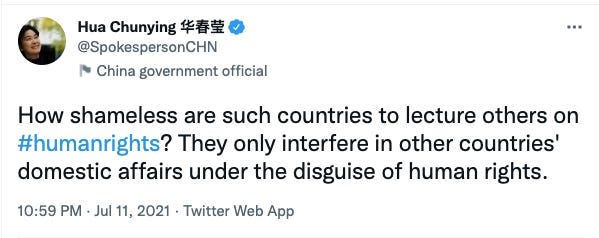
Chinese Communist Party officials, for example, often criticize the west (specifically the US) for a lack of respect for "sovereignty," calling any critique of China "external interference in domestic affairs."
In the USA (and to a lessor extent Canada) we get the narrative of "culture wars," the need to raise children free from (state) interference (mandated vaccinations, views on religion, etc.), in order to protect values, which are being threatened by global elites. In the same countries we also find a growing movement for indigenous sovereignty.
In a seeming contradiction, these assertions of sovereignty are coming at a time when the limits to sovereignty — the mythology presupposed in the concept — seem to be more clear than ever.
Why then are these assertions being made now? And what are the consequences likely to be?
To answer these questions, I review the “security dilemma,” which is a central theoretical limitation to sovereignty as stated within international relations theory. I then consider how two increasingly apparent limits may interact with the theoretical one, as our desires for security lead us closer and closer to the brink of tragedy.
The foundational theoretical constraint on sovereignty: the security dilemma
In international relations theory a key aspect of the relation between sovereign states is captured in what is called the security dilemma. This dilemma exists because, in a state of international anarchy (i.e. without a supra-government enforcing an international system of law), "the means of security for one state are, in their very existence, the means by which other states are threatened" (Waltz, Theory of International Politics).
A contemporary example of the security dilemma:
China’s government criticized the record budget request [by Japan in 2021]. Japan is “trying to find excuses to justify their decision to increase military spending,” Foreign Ministry spokesman Wang Wenbin said at a regular briefing in Beijing. “China hopes Japan can do things that are conducive to regional peace more than the opposite,” he added.
Japan’s defense spending was about a fifth of China’s in 2019, according to the Stockholm International Peace Research Institute (Source).
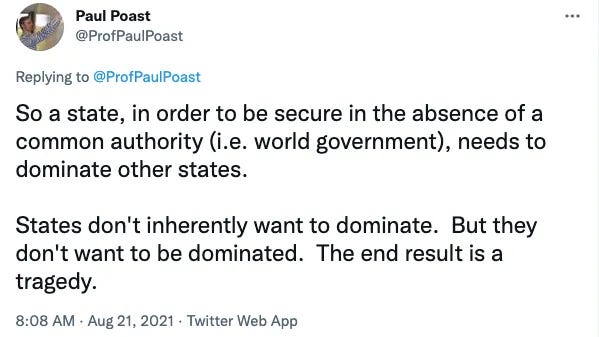
That is, in order to achieve and maintain a state of self-determination with non-interference in domestic affairs (i.e. to achieve and maintain sovereignty), each country must engage in behaviour that antagonizes/intimidates other states, resulting in a feedback loop of fear and fortification. Even if this process does not result in outright war, it modifies thought and behaviour (both foreign and domestic policy) within all countries, revealing the extent to which we are determined by our relationships.
This dilemma, which emerges as soon as we encounter the Other, demonstrates how the desire for sovereignty is itself a force that undermines, or limits, self-determination (states are forced to act in ways that they would prefer not to), even leading to direct military intervention (the biggest violation of sovereignty).
It follows from this theory, that in order to have some satisfactory level of sovereignty free from interference (or an unacceptable threat of war), each nation or state would have to agree to limit its sovereignty and accept a common rule of law.
Emerging limits
There is now a large body of literature as well as general awareness of the concept of the Anthropocene, as a geological epoch in which human beings take over the central role in modifying the earth's systems.
While there is still debate over when this epoch began, it is clear that climate change and the proliferation of plastics — specifically microplastics, which travel through water ways, weather systems and organisms that do not respect borders — mean that no part of the earth is untouched or free from the consequences of actions occurring elsewhere.
This leaves governments and citizens forced to encounter problems that they are not (entirely) responsible for, and that they are incapable of addressing without full international participation.
Thus, in an emerging ecological extension of the security dilemma (as I argued here), governments shy away from fully addressing their part in these emergent problems, as they fear the risk to their (economic) security should they act more decisively. In doing so they contribute further to the environmental problems that everywhere undermine sovereignty.
The second emerging limit, which barely needs comment, is how cell phones combined with internet and social media mean that the education of our children is now not only largely out of our hands, but also out of the hands of our neighbours and extended families.
Attempts to increase national (or cultural) security by restricting access to certain social media (say in China or Russia, or by parents within certain communities) diminish understanding between groups, and makes propaganda more effective, both of which heightens tensions.
These emerging limits are combining to mean that even governments of the most powerful states are increasingly facing pressures that they have limited to no ability to control on their own (see also here). I.e. they are more frequently and forcefully encountering the limits of their sovereignty.
Sovereignty, it seems, is currently both more clearly mythological than actual, yet more desired than ever.
Conclusion
While all this clearly makes international cooperation highly rational, the security dilemma (and game theory generally) should make clear the precarity of our position.
The failure of globalism — at least on certain matters — to continue to limit the costs of international anarchy, has coincided with louder calls emerging from various disciplines (philosophy, anthropology, ecology, etc.) that emphasize that when a particular is posited as universal, an excluded "remainder" is left, which is unaccounted for and lacks representation within the dominant order. This lack of representation — it is argued by a wide variety of groups with different politics and in different contexts — threatens the survival of these groups.
That is to say we find increasing anxiety about a growing array of perceived threats, a turn away from universalism, and rather than international cooperation, we get an exacerbation of the security dilemma, which increases the threat of war.
Meanwhile, as emerging trends combine to undermine sovereignty we could very well see increasing seccessionist sentiment within states, as groups no longer feel secure under their governments, and so seek to take security into their own hands. Such civil unrest would likely increase fear within governments (including of external meddling influencing these seccessionist movements), and so result in a turn to authoritarian and totalitarian tactics in an attempt to re-affirm sovereignty, against both internal and external actors.
Is there a way to prevent an accelerating security dilemma from sending the earth spiralling into a state of war and ecological chaos?