
Dithering on Decarbonization
Part 1: Game theory and climate action

This short article was first published as a twitter thread on August 11, 2021.
"... by the standards of domestic society, international institutions are weak. Cheating and deception are endemic" (Achieving Cooperation under Anarchy, Axelrod and Keohane).
Over the last few years internal pressure for prompt action to mitigate climate change has grown in developed nations, thanks to the work of several large, international activist groups.
But while groups like Greta Thunberg’s “Friday’s for Future,” Extinction Rebellion and 350 have increased pubic awareness, these groups continue to point out that we must “mind the gap,” between what governments are saying and what they are doing. Even amongst western nations with democratic institutions that are susceptible to internal pressure, actions taken so far will not bring us anywhere close to the 1.5 or 2C goals of the Paris agreement.
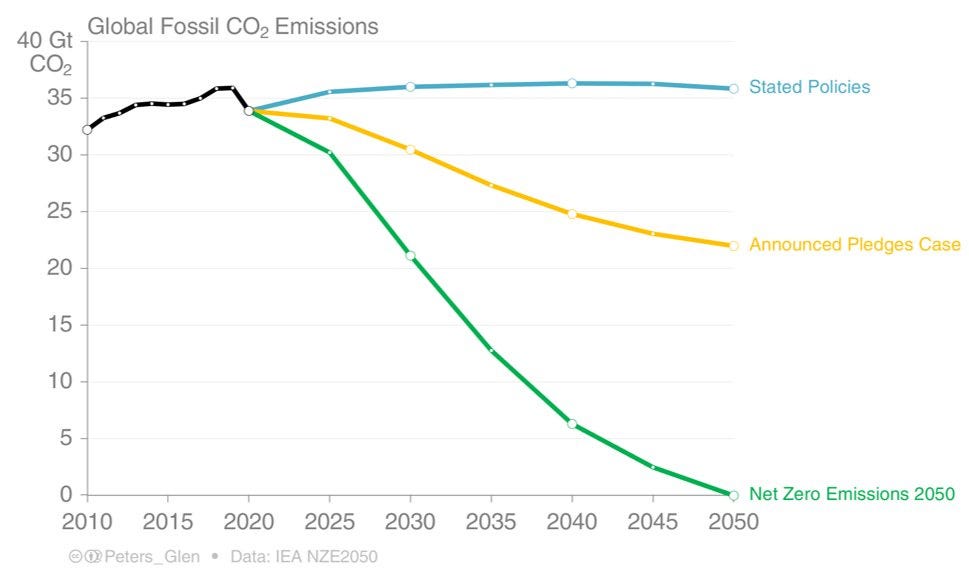
This is particularly true of countries that produce and export fossil fuels (coal, gas, oil), such as Australia, Canada and Norway.
While citizens, activist groups and scientists continue to apply pressure on government in these countries, few of those groups have seriously considered why there has been so little success. (A disproportionate influence by industry over government is generally assumed to be the answer, and there are near unanimous cries for "systemic change," though few specifics are provided as to what this would look like. Activists continue to be baffled by the way governments of all major political parties act, in spite of ministers within these governments being fully aware of what the science is saying).
Is there no theory to help us understand why Paris plus moralistic internal pressure seems to be failing?
I am not the first to point out that the climate change problem can be viewed in terms of game theory, in particular the Prisoner's Dilemma (see, for example, Thinking Like a Mall by Steven Vogel). In that game, the optimal solution is the cooperation of all participants, but, because all it takes for all but one player to have the worst possible outcome is for one of the others to "defect," the fear of the worst outcome means the "Nash equilibrium" or default solution to the game is that participants cheat and accept the less than optimal, but not worst, outcome.
In the context of decarbonization efforts, the optimal solution would be for everyone to do what is required to minimize warming as much as possible by decarbonizing as rapidly as possible. (The figure given as the optimal target from a scientific standpoint is under 1.5C of warming, though many scientists believe this is practically impossible. There have also been claims by economists, such as William Nordhaus, that 4C is the optimal warming. It is also a noteworthy fact that the impacts of passing the 1.5C limit are not projected to be evenly distributed across all countries).
The desire to cheat arises, predominantly, due to the knowledge that there is no authority that can force participants to adhere to any pledges or commitments, and that abruptly shutting down the portion of your country's economy tied up with fossil fuel production and consumption is no guarantee that others will do the same. Therefore, you may both suffer the consequences of extreme global warming and the economic (and political) consequences of rapidly decarbonizing; given how "endemic" cheating and deception are at the international level, it is irrational to assume other players will not do so.
Within the current global context an additional pressure towards cheating exists. Experimental evidence demonstrates "that the greater the conflict of interest between the players, the greater the likelihood that the players would in fact choose to defect" (Axelrod and Keohane). That means that the recent spike in tensions between the west and China and Russia means that not only are those countries virtually insusceptible to internal pressure to decarbonize (what so far has been relied on as the mechanism for forcing action), but they may have other political incentives towards "defecting." The difficulty is made even greater by the fact that both of these countries are considered "developing nations," within the Paris Agreement, meaning they have been granted later target dates for peaking their emissions. This grants these nations a potential cover for a planned defection (and extended advantage) that increases the pressure on western nations to defect given the high levels of distrust.
Players that perceive each other as enemies are less likely to find a path to cooperation, and more likely to defect, believing that the other player will also be seeking any advantage possible. In the case of Russia, it is believed by their government that a moderate amount of warming will bring an economic advantage by expanding the productive agricultural region of Russia, and opening up the Arctic Ocean to a summer shipping route controlled by Russia (since sea ice is disappearing more abruptly from Russian seas than on the North American side). The Russian government and media often downplay the consequences of climate change (as we also find in western media, to a lesser extent).
While one of the costs expected from climate change is a worsening refugee crisis, the Russian and Chinese governments are immune to arguments about their moral obligations to take in refugees (China issued ~1,500 permanent residence status cards in 2016, compared to the U.S. 1.2 million). Russia and China are also somewhat immune to military pressure, as they both hold stockpiles of nuclear weapons.
Finally, in the case of relying on internal pressure within many developing countries, not only are these governments less susceptible to pressure from citizens and activist groups, but there tends to be less public awareness of climate change; i.e. climate change is not perceived as a threat, because it is not understood (see chart below).
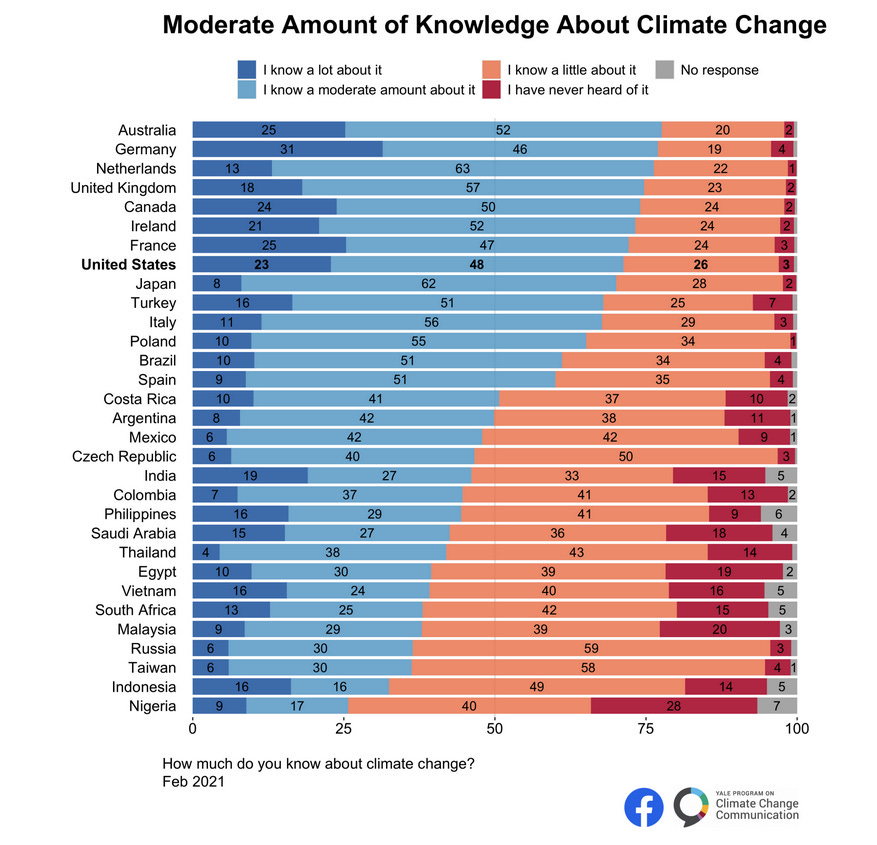
These countries also have a strong desire to continue their development, and often feel that there is a historic injustice in terms of how small the proportion of CO2 they have emitted compared to developed nations. If they believe that they are likely to suffer many negative consequences from climate change no matter what they do, they may be more likely to defect.
What's the alternative to relying on Paris for a general framework and and the internal moralist pressure from citizens to ensure an optimal (or non-disastrous) solution?
… Another thread for another day…